
1535696
Description

Flashcards by Susannah Mackenz, updated more than 1 year ago

|
Created by Susannah Mackenz
about 11 years ago
|
|
| Question | Answer |
| Habituation | Decrease in response strength to a repeated stimulus |
| Decreased sensory response to a repeated stimulus | Sensory adaptation |
| Increase in the strength of the response to a repeated stimulus | Sensitization |
| Classical conditioning | procedure in which a formerly neutral stimulus (the conditioned stimulus) comes to elicit a conditioned response by virtue of being paired with an unconditioned stimulus that naturally elicits a similar response (the unconditioned response) |
| He noticed that with repeated testing, the dogs began to salivate before the food was presented, such as when they heard the footsteps of the approaching experimenter. | Pavlov |
| Acquisition | Period when the response is being learned |
| Neutral stimuli | Does not trigger a response |
| Unconditioned Stimulus | Stimulus that produces response innately, without it being learned. |
| Conditioned stimulus | Neurtal stimulus that evokes a conditioned stimulus Learned after being associated with an unconditioned stimulus |
| Conditioned response | Achieved after pairing a conditioned and unconditioned stimuli that produce similar responses. |
| UCS | Unconditioned Stimulus |
| CS | Conditioned Stimulus |
| UCR | Unconditioned response |
| CR | Conditioned response |
| Stimulus that innately has a response | Unconditioned stimulus |
| A stimulus that gains value through learning | Conditioned stimulus |
| Reflexive unlearned response to innately important stimulus | Unconditioned response |
| Conditioned response | Response from a stimulus whose importance results from past learning |
| Ex: food | UCS |
| Ex: Sight of Favourite restaurant | CS |
| Salvation in response to food | UCR |
| Feeling hungry when you see your favourite restaurant | CR |
| Extinction | Absence of past reinforcement producing a response; weakened response that eventually stops |
| Spontaneous recovery | Reappearance of previously extinguished conditioned response after extinction and a time interval |
| a CR occurs to stimuli other than the original CS, based on the similarity of these stimuli to the CS | Stimulus generalization |
| occurrence of a CR to one stimulus but not to another stimulus | Discrimination |
| POSITIVE, NEGATIVE...E.TC | STUDY!!! |
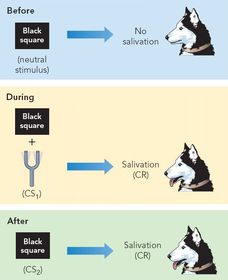
| in classical conditioning, when a neutral stimulus becomes a CS after it is paired with another CS (rather than with the original UCS) | hIGHER-ORDER CONDITIONING |
|
What does this process represent?
Image:
bad (image/jpg)
|
Before, during, and after high-order conditioning ! |
|
Image:
rfffffgsffg (image/jpg)
|
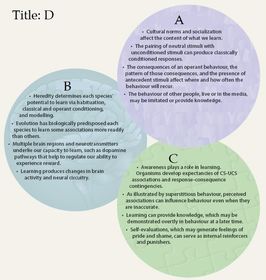
A: environmental B: biological C: Psychological D: Levels of analysis of learning |
| Therapeutic techniques designed to extinguish anxiety responses by exposing clients to anxiety-arousing stimuli or situations while preventing escape or avoidance | Exposure therapies |
| the pairing of a CS that currently evokes a positive but maladaptive response with a noxious UCS in an attempt to condition repulsion toward the CS | Aversion therapy |
| Thorndike | Instrumental learning Law of Effect |
| Thorndike's concept that a response followed by satisfying consequences will become more likely to occur, whereas a response followed by unsatisfying consequences will become less likely to occur | Law of effect |
| Operant conditioning | a type of learning in which behaviour is modified by its consequences, such as by reinforcement, punishment, and extinction |
| an experimental chamber in which animals learn to perform operant responses, such as bar presses or pecking responses, so that the learning process can be studied | Skinner Box |
| the strengthening of a response by an outcome that follows it | Reinforcement |
| Punishment | response is weakened by an outcome that follows it; opposite of reinforcement |
| Discriminative stimulus | an antecedent stimulus that signals the likelihood of certain consequences if a response is made |
| a response is strengthened by the subsequent presentation of a (positive) stimulus | Positive reinforcement |
| a response is strengthened by the subsequent removal of a (noxious) stimulus | Negative reinforcement |
| the weakening and eventual disappearance of a response because it is no longer reinforced | Operant extinction |
| occurs when a response is weakened by the subsequent presentation of a (noxious) stimulus | Positive punishment |
| the removal of a (positive) stimulus following an undesired response to weaken it (e.g., TV privileges are taken away from a misbehaving child who wants attention) | Negative punishment |
| Primary reinforcers | positive reinforcers that satisfy biological needs, such as food and water |
| a stimulus that acquires reinforcing qualities by being associated with primary reinforcers | Secondary/ conditioned reinforcers |
| the ability to forgo immediate rewards for delayed but more satisfying outcomes | Delay of gratification |
| an operant conditioning procedure in which reinforcement begins with a behaviour that the organism can already perform, and then is made contingent on behaviours that increasingly approximate the final desired behaviour | Shaping |
| an operant conditioning procedure used to develop a sequence (chain) of responses by reinforcing each response with the opportunity to perform the next response | Chaining |
| an operant response occurs to a new antecedent stimulus that is similar to the original antecedent stimulus | Operant generalization |
| an operant response occurs when a particular antecedent stimulus is present, but not when another antecedent stimulus is present | Operant discrimination |
| Continuous reinforcement schedule | a reinforcement schedule in which each correct response is followed by reinforcement |
| a schedule in which reinforcement follows some correct responses but not others | Partial reinforcement schedule |
| a reinforcement schedule in which reinforcement is given after a constant number of correct responses | Fixed ratio schedule |
| a schedule in which reinforcement is based on an average but variable number of responses | Variable-ratio schedule |
| a reinforcement schedule in which the first correct response occurring after a constant time interval is reinforced | Fixed-interval schedule |
| a schedule in which reinforcement follows the first correct response that occurs after an average (but variable) time interval following the last reinforced response | Variable-interval schedule |
| a form of learning in which the organism learns to perform a behaviour to escape from an aversive stimulus | Escape conditioning |
| the conditioning of an organism to perform a response to avoid an undesirable consequence | Avoidance conditioning |
| theory that avoidance learning first involves the classical conditioning of fear, followed by learning operant responses that avoid an anticipated aversive stimulus and thus are reinforced by anxiety reduction | Two factor theory of avoidance learning |
| a procedure in which desirable behaviours are reinforced with tokens or points that can later be redeemed for other reinforcers | Token economy |
| also called <em>behaviour modification</em>) in which operant conditioning is combined with scientific data collection to solve individual and societal problems | Applied behaviour analysis |
| The caged animals experiment | STUDY |
| the notion that evolutionary factors have produced an innate readiness to learn certain associations that have had survival implications in the past | Preparedness |
| a learned repulsion to a food that formerly was neutral or desired, by virtue of pairing the food with an aversive UCS (e.g., nausea, stomach illness) | Conditioned taste aversion |
| the tendency for innate behaviours to override a conditioning procedure, thus making it difficult to create or maintain a conditioned response | Instinctive drift |
| in Gestalt psychology, the sudden perception of a useful relationship or a solution to a problem; in psychoanalysis, the conscious awareness of unconscious dynamics that underlie psychological problems | Insight |
| a mental representation of the spatial layout of an area | Cognitive map |
| learning through observing the behaviour of a model | Observational learning |
| the view that hypnotic experiences occur because people are highly motivated to assume the role of being “hypnotized” | Social-cognitive theory |
| Bandura's former name for <em>social-cognitive theory.</em> | Social learning theory |
| the conviction that we can perform the behaviours necessary to produce a desired outcome | Self-efficacy |
Want to create your own Flashcards for free with GoConqr? Learn more.