
4946884
Description

Flashcards by David Alty, updated more than 1 year ago

|
Created by David Alty
over 9 years ago
|
|
| Question | Answer |
| Benzene | classified as carcinogen, colourless liquid with a sweet odour. highly flammable it can form naturally in volcanoes and forest fires. |
| kekule and problems | -didn't explain low reactivity -all lengths are the same not different (c-c long c=c short) -enthalpy change of less than expected |
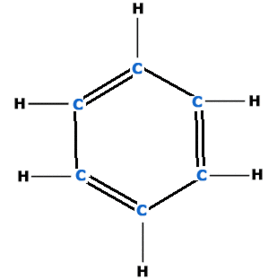
| real structure of benzene | |
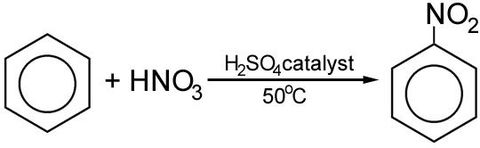
| nitration of benzene | |
| halogenation of benzene | |
| phenol + sodium | |
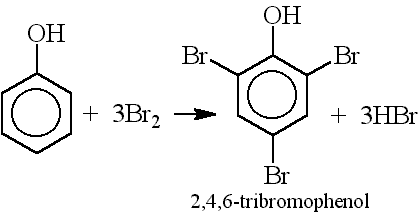
| phenol + bromine | |
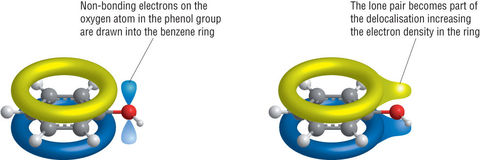
| phenol structure | |
| uses of benzene | detergents, explosives, pharmaceuticals and dyestuffs |
| uses of phenols | alkyl-phenols: surfactants and detergents chloro-phenols: antiseptics and disinfectants salicylic acid: aspirin and pharmaceuticals bisphenol: production of epoxy resins for paint |
| oxidation agent for alcohol-> aldehyde-> carboxylic acid | potassium dichromate(VI) (orange -> green) |
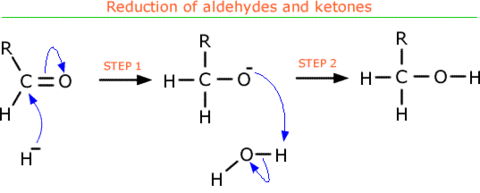
| reduction of aldehydes +mech | NaBH4 (sodium borohydride) |
| 2,4-DNP | 2,4-DNP (2,4-dinitrophenylhydrazine) + methanol + H2SO4 (Brady's reagent) +aldehyde or ketone = yellow/orange preciptate. impure product is filtered, recrystallised to produce pure. dried and melted to find the carbonyl compound |
| aldehyde or ketone | tollen's reagent (weak oxidising) created: NaOH(aq) + AgNO2(aq)-> AgO (brown precipitate) dilute NH4 until precipitate is gone. creates a silver mirror in the presence of a aldehyde. |
| esterification classic | |
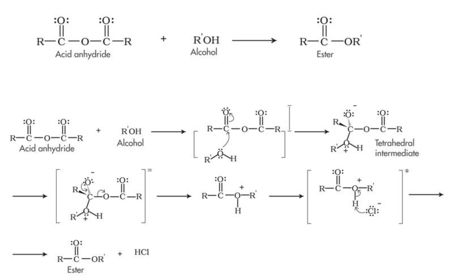
| acid anhydride | |
| ester uses | cosmetics and flavourings |
| naming convention of fats and triglycerides | Octadec-9,12-dienoic acid -> 18:2 (9,12) three carboxyls + glycerol = 3 ester bonds |
| HDL + LDL | High density lipoproteins: Good, cholesterol out Low density lipoproteins: bad, chelosterol into blood deposit on artery |
| amines + naming | Amines: smell bad two ethyls= N,N |
| aliphatic amine | = (warm) halogenoalkane + (excess)NH4 |
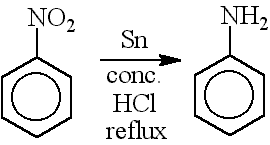
| aromatic amine | |
| Diazotisation | NaNO2+HCl->HNO2+NaCl (<10c) |
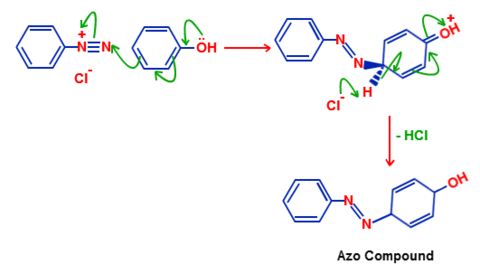
| Coupling | +NaOH Brightly coloured compound used as dye |
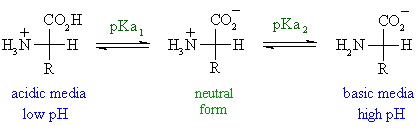
| Amino acids | neutral=zwitterion |
| acid hydrolysis and aklali hydrolysis of amino acids | acid: reflux 6moldm-3 HCl for 24hrs alkali: NaOH + 100oC |
| biodegradable plastics | -Poly(lactic acid), poly(glycolic acid) -photo degradable |
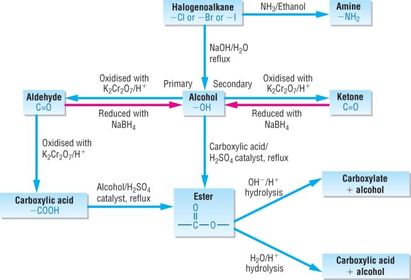
| Organic synthesis of aliphatic compounds | |
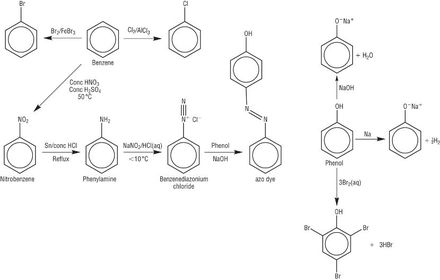
| important aromatic reactions | |
| problems chirality | -less pharmacologically active ingredient -potentially toxic -dosage confusion -case study: thalidomide baby deformities, seldane antihistamine isomer heart attacks |
| solutions to chirality | -enzymes -using correct chiral ingredients -transition element complexes |
| thin-layer chromatography + limitations | stationary=silica gel(SiO2), alumina(Al2O3) mobile=liquid solvent solid stationary phase (adsorption), Mobile phase -similar compounds similar Rf -unknown compound=unknown Rf -tricky to separate properly |
| calculate Rf | Rf=distance compound moved /distance solvent moved |
| GC chromatography + limitations | to separate volatile compounds solid/liquid stationary coating tube retention time -same retention time -not all separated/detected -unknown have no reference |
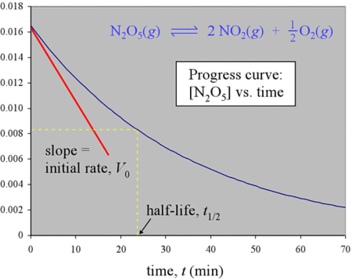
| initial rate of reaction | |
| orders + rates | zero=x[A]^0 first=x[A]^1 second=x[A]^2 rate=k[A][B] rate determined by the slow |
| Kc= + what effects | =products/reactants -temperature shifts, conc + press=no effect |
| def of acid + base | Bronsted-Lowry acid=substance that proton can be removed from Bronsted-Lowry base=substance that proton accept a proton |
| mono-, di and tri acids | 1proton, 2protons, 3protons |
| acid w/ metals | salt + hydrogen tip= avoid H2SO4 + HNO3 when giving examples as they are stong oxidising agents |
| Ka= | =[H+][A-]/[HA] [A-]=[H+] in weak acids [H+]=¬|Ka[HA] pKa=-log(10)Ka <> Ka=10^-pKa |
| Kw= | =[H+]x[OH-] or =Kc x [H2O] |
| buffers | nough said |
| titration and indicators | equivalence point= centre of vertical bit end point= equal conc of acid and base OF INDICATOR choose indicator that has an endpoint as close to the equivalence point as possible |
| enthalpy change of nuetralisation | 1. Q=m.c./\T (joules) 2. amount of mol reacted 3.scale molar quantities to match 4. formation of one mole from neut |
| /\Hf= | everything else |
| compare NaI to AlCl3 | AlCl3 more exothermic as Al is +3 so much smaller and 3 times Cl has less shells |
| /\G= +feasibility | /\H-T/\S |
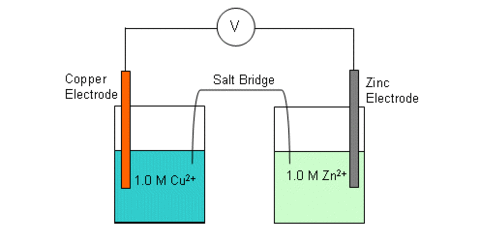
| how to make a cell between zinc and copper | salt bridge made out of filter paper + KNO3 or NH4NO3 (unreactive) |
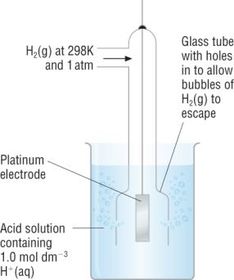
| hydrogen half cell | |
| feasibility of cells (choosing which way round) | always subtract the lowest one |
| cells (batteries) | 1. non-recharge= once 2. recharge= chemicals can be reversed (nickel and cadmium or lithium ion) |
| advantages of fuel cells storage of hydrogen limitations | obvs co2 + more efficient stored: pressure, on solid, in solid -transport + large storage -toxic chemicals in production -fuel cells have limited lifespan |
| transition element + anomolys | a d-block element that forms an ion with an incomplete d sub-shell -chromium and copper |
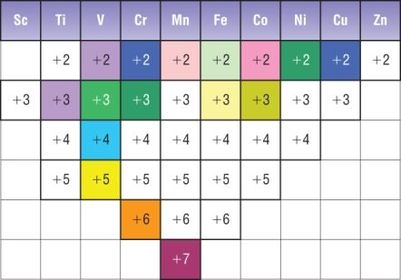
| transition oxidaion colours | |
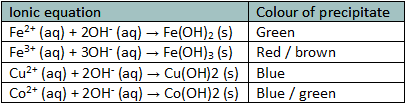
| transition precipitation | Co starts pink, Fe2+ starts green, Fe3+ starts yellow, Cu starts blue |
| ligand substitution reactions of copper with NH3 | [Cu(H2O)6]2+ (pale blue) ->Cu(OH)2 (pale blue precip) ->[Cu(NH3)4(H2O)2]2+ (deep blue) |
| ligand substitution reactions of copper with Cl | [Cu(H2O)6]2+ (pale blue) ->[CuCl4]2- (yellow) (green colour when only halve has reacted) |
| ligand substitution reactions of cobalt with Cl | [Co(H2O)6]2+ (pink solution) ->[CoCl4]2- (blue solution) |
| Kstab= | products/reactants (forget water) |
| MnO4- + Fe2+ | MnO4- +8H+ +5Fe2+->Mn2+ +5Fe3+ +4H2O (MnO4-=purple -> Mn2+=near colourless) |
| CuI | white precip |







Want to create your own Flashcards for free with GoConqr? Learn more.