
5154334
Description

Flashcards by Hayley Harrison, updated more than 1 year ago

|
Created by Hayley Harrison
over 9 years ago
|
|
| Question | Answer |
| Marine Fouling | -an unwanted growth of organisms on a surface -cost of $1 billion due to drag friction |
| Fouling Succession | -primary (molecular fouling): seconds to hours -secondary (microfouling): hours to days -tertiary (macrofouling): up to 1 year |
| Anti-fouling Coatings | -leaching (biocides) -non-leaching (release) |
| Non-coating | -water treatment -surface treatment cleaning |
| Invasive Species | -seaweed uses: food staple, food gum, maerl, cosmetics, medicine -changes to industry: increased mechanization, inclusion of fast-growing species/varieties |
| Cultivation Methods | -regeneration and self-seeding -fragmentation and fertile adults -requires knowledge of the species |
| Mariculture | -improving sea conditions -improving plant material -creates artificial environments -depends on algae |
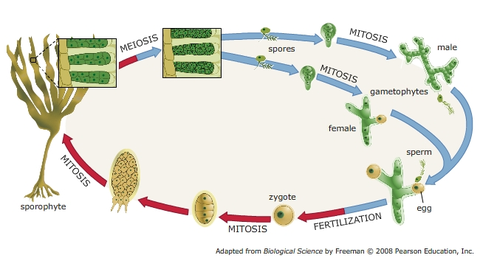
| Cultivation of Laminaria | -natural life-history and forced cultivation -spore seeding: zoospore seeding, gametophyte seeding, out-growing -Gracilaria: bottom stacking, rope farming, pond farming, tank production |
| Laminaria Life Cycle | |
| Cultivation Contamination | -prevention: pre-treatment, site cleaning, filtration, maintenance, conditions controlled -control methods: replacement, grazers, chemicals, removal, drying |
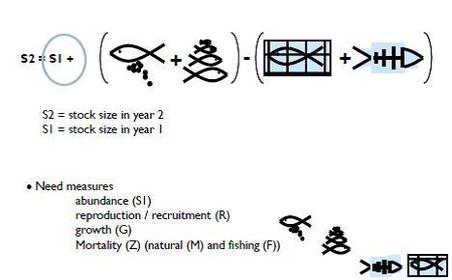
| Fishery Patterns | -stocks: basic management unit (varied in response) -depensation: loss of reproductive capacity with decreasing stock size |
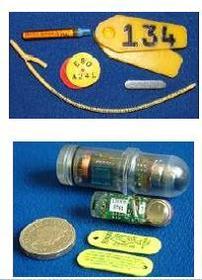
| Stock Monitoring | -stock monitoring: natural and artificial markers, phenotypic characteristics,. genetic data |
| Fishery Stock Variation | |
| Stock Recruitment | R= (a x s) / L + (b x s) |
| Fish Stock Growth | -estimating expected yield: surplus production, yield per recruit -trophic models: account for biological interactions, models based on energy flow, implications of change in one component |
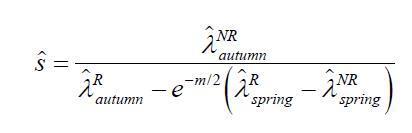
| Estimating Fishing Mortality | |
| Fishing and Climate | -under intensive exploitation, populations undergo critical changes: mature early, smaller adult, short life-span, shift in maturation reaction -in heavily exploited populations: more adults killed by humans than natural causes |
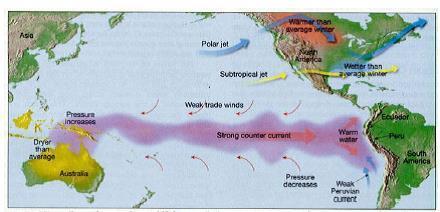
| Large Scale Climate Variation | -Large scale variation: El Nino southern oscillation (ENSO) |
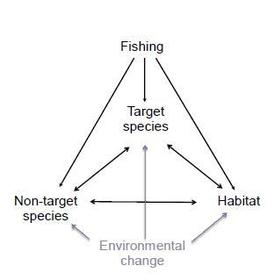
| Environmental Change On Target Species | |
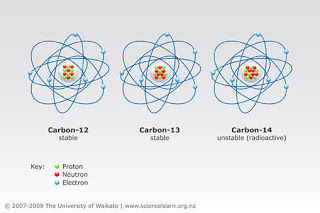
| Stable Isotopes | |
| Marine Biological Invasions | -induction vectors: aquaculture, ballast water, fouling, artificial canals, aquariums -natural dispersal pathways: leading-edge dispersal corridors, long-distance dispersal -artificial pathways: mass dispersal, cultivation |
| Biological Invasion Sequence | -transport -colonization -dispersal -impacts |
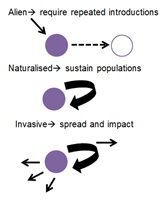
| Introduced Species | |
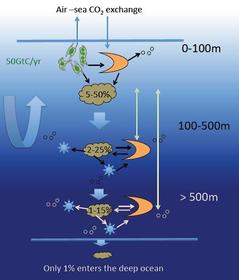
| Deepwater Fishes, Carbon and Ecosystem Services | -mesopelagic food web is very efficient so it prevents long term storage of carbon (can be overwhelmed or bypassed) -difficult to assess the abundance of mesopelagic fish -1,000,000-2,500,000 tonnes of C stored per year |
| Carbon Storage | |
| Marine Wood Borers | -significance of biodegraders: biodeterioration, biotech potential, ecosystem services -As a food source: non-ingesters, microorganism users, particulate feeders, independent digesters, kleptoenzymes |
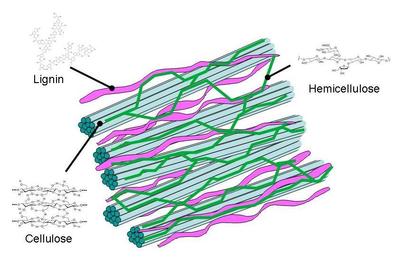
| Lignocellulose, hemicellulose and lignin | -lignocellulose: long chain polymer -hemicellulose: branching polymers -lignin: hydrophobic |
| Particulate Feeders | -the gland of deshayes: mass of brown tissue lining the brachial vein that fixes inorganic nitrogen -nitrogen conservation: grooming, species excretion |
| Aquaculture | -use of ~300 species -no species is ideal and must be manipulated (direct or genetic) |
| Induced Triploidy in Aqauculture | -change in chromosome number (2n to 3n) to give infertile males -pressure shock, heat shock -problems: competition, escape, sexually maturing males |

Want to create your own Flashcards for free with GoConqr? Learn more.