
5952939
Description

Flashcards by Kisha Limose, updated more than 1 year ago

|
Created by Kisha Limose
over 9 years ago
|
|
| Question | Answer |
| Groups of cells that similar in structure and function are called ? | Tissues |
| How many primary tissues types are found in the human body? | 4 -connective -epithelial -muscle -nervous |
| True or false . endocrine and exocrine glands are classified as epithelium because they usually develop from epithelial membranes . | True |
| epithelial tissues can be classified according to cell shape. _______ epithelial cells are scale-like and flattened . | squamous |
| this type of epithelium lines the digestive tract from stomach to anus | simple columnar |
| all connective tissue derive from an embryonic tissue known as | mesenchyme |
| all of the following are examples of connective tissue except : a. bones b. ligaments c. neurons d. tendons | c. neurons |
| true or false . blood is a type of connective tissue ? | true |
| of the two major cell populations in nervous tissue, (neurons/ neurogolial cells )are highly specialized to receive stimuli and conduct waves of excitation to all parts of the body. | neurons |
| how many basic types of muscle tissues are there ? | 3 -cardiac -skeletal -smooth |
| This type of muscle tissue is found in the walls of hollow organs. it has no striations, and its cells are spindle shaped | smooth muscle |
| define organs | to perform specific body functions, what tissues are organized into . |
| _____ is the study of tissues | histology |
| this type of tissue covers the external body surface . | Epithelial tissue (or epithelium) |
| epithelial functions include : | -protection -absorption -filtration -excretion -secretion -sensory reception |
| simple epithelia consists of : | one layer of cells attached to the basement membrane |
| stratified epithelia consists of : | consists of two or more layers of cells |
| general types of cell shapes | -cuboidal (cube) -squamous (flat/scale) -columnar (column shape) -Transitional -pseudostratified |
| Function of the Endocrine Glands | referred as the 'ductless gland' they secrete hormones which enter the blood or lymphatic vessels. |
| Function of Exocrine | retain their ducts, and their secretions, empty through ducts to an epithelial surface. (sweat, oil glands, liver and pancreas) both internal and external |
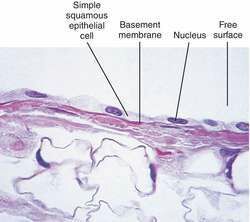
| Simple Squamous | Single layer of flattened cells Function : allows passage of materials by diffusion and filtration Location: kidney glomeruli, air sacs of lungs, lining of heart b.v., lymphatic v., lining of ventral body cavity (serosae) |
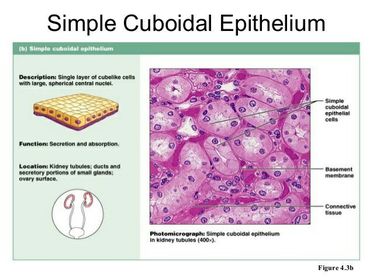
| Simple cuboidal epithelium | single layer of cube-like cells, with large nuclei Function : secretion and absorption |
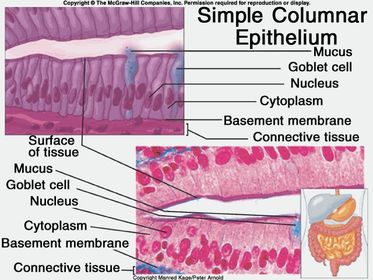
| Simple columnar | single layer of tall cells, with round oval nuclei, may contain muscus secreting, golbet cells. Function : absorption, secretion of mucus, enzymes, other substances Location: (digestive tract (stomach-anus) uterine tubes, regions of uterus) |
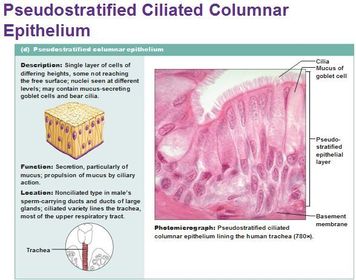
| pseudostratified columnar | single layer of cells of different heights, some reaching the free surface. Function : secretion of mucus |
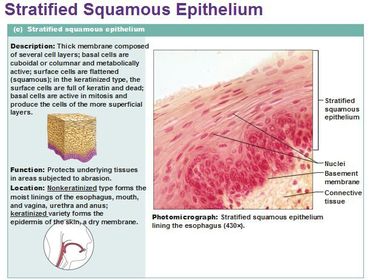
| Stratified Squamous | thick membrane comopsed of several layers, basal cells are cuboidal, surface cells are flattened(squamous) Function: protects underlying tissues in areas subjected to abraison. |
| Transitional Epithelium | basal cells are cuboidal or columnar, surface cells are squamous like depending on the degree of the organ stretched. Function: stretches and permits unfolding of urinary organ. |
Want to create your own Flashcards for free with GoConqr? Learn more.