
20603677
Description

Flashcards by Josefine Marie, updated more than 1 year ago

|
Created by Josefine Marie
almost 6 years ago
|
|
| Question | Answer |
| Importance of Disaster Planning | Disaster: eg catastrophes or smaller events like building fires. - Customers want assurance that business can continue after disaster - Employees might choose to take care of their families first as supposed to be concerned with company survival |
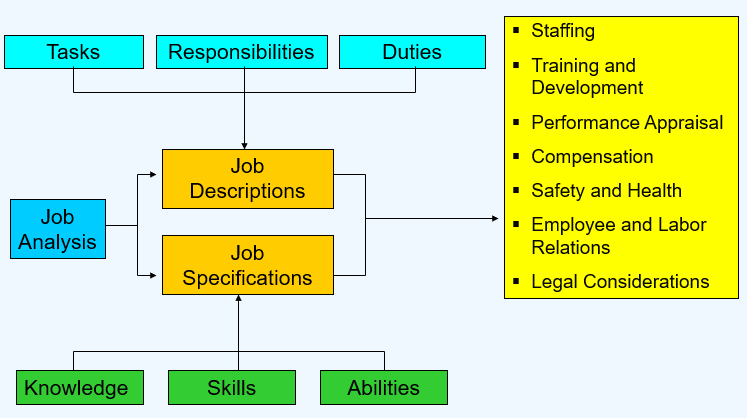
| Job Analysis | Systematic process of determining: - Skills - Duties - Knowledge required for performing jobs in an organization |
| Job Analysis as a basic human resource tool | |
| Reasons for doing Job Analysis | - When organization is founded and a job analysis program is initiated - When new jobs are created - When existing jobs are changed significantly |
| Job analysis should answer | - What physical and mental tasks does the worker accomplish - When is the job to be completed - Where is the job to be accomplished - How does the worker do the job? - Why is the job done? - What qualifications are needed to perform the job? |
| Various Job Analysis methods | - Questionnaires - Observation - Interviews - Employee Recording - Combination of Methods |
| Who conducts Job Analysis | Peope who participate in job analysis should at minimum be: - Employee - Employees immediate supervisor |
| Components of a Job Description | - Tasks, Duties and Responsibilities. - percentage of time each duty, performance standards, working conditions, number of employees performing job, who to report to, machines and equipment used for job - J Identification, J Analysis Date, J Summary, Duties performed |
| Standard Occupational Classification (SOC) | - Job Descriptions for all US workers in more than 800 occupations - 2010 SOC replaces the 2000 system - This update permits professional organizations + labor groups to seek recognition or a higher profile for their members’ occupations by gaining a separate listing or reclassification. |
| O*NET, Occupational Information Network | - Comprehensive government-developed database of: Worker attributes + Job characteristics - Primary source of occupational information |
| Job Analysis for Team Members | - With team design there are no narrow jobs - Work that departments do is often bundled into teams |
| Human Resource Manager as a strategic partner | HR Professionals are increasingly expected to act as a strategic partner with upper management |
| Strategic Planning Process | - Process top management determines overall organizational purposes +objectives +how to be achieved - four steps 1. Mission Determination 2. Environmental Assessment 3. Objective Setting 4. Strategy Setting |
| Human Resource Planning Process | - Process of matching internal and external supply of candidates with job openings. Checking requirements and availability: Demand=Supply - no action Surplus of workers - downsizing etc Shortage of workers - recruitment, selection |
| Forecasting Human Resource Requirements and Availability | Determining Number, Skills, Location of employees that organization will need at future dates in order to meet goals. - Zero Base forecast (use current level of staffing as starting point) - Bottom up forecast (each level of firm forecasts its requirements to aggregate employment needs) - Sales/Number of workers - Availability forecast |
| Human Resource Databases | contain employee information - permit management to make HR decisions - many workers needed for future positions likely already work for firm |
| Shortage of workers | - innovative recruiting - compensation incentives - training programs - modified selection standars |
| Surplus of workers | Restricted hiring, reduced hours, early retirement, layoffs, downsizing |
| Strategic succession planning | - Process of ensuring that qualified persons are available to assume key managerial positions once the positions are vacant - goal is to help ensure a smooth transition and operational efficiency |
| Manager Self-service | - use of software and corporate network to automate paper-based processes - reduce the administrative workload for HR - Give managers more control over HR processes |
| Employee Self-Service | - Processes that automate formerly labor-intensive transactions for employees and HR professionals _ ESS applications can free up valuable HR staff time, reducing administrative time and costs |
| Job Design | Process of Determining: - specific tasks to be performed - Methods used in performing these tasks - How a job relates to other work in orgnaization - Job Enrichment, Job Enlargement, Job Rotation, Reengineering |
| Importance of global talent management | builds culture, engagement, capability and capacity through integrated talend acquisition, development and deployment processes that are aligned to business goals |
Want to create your own Flashcards for free with GoConqr? Learn more.